Two Haplogroups and 70,000 Years of History
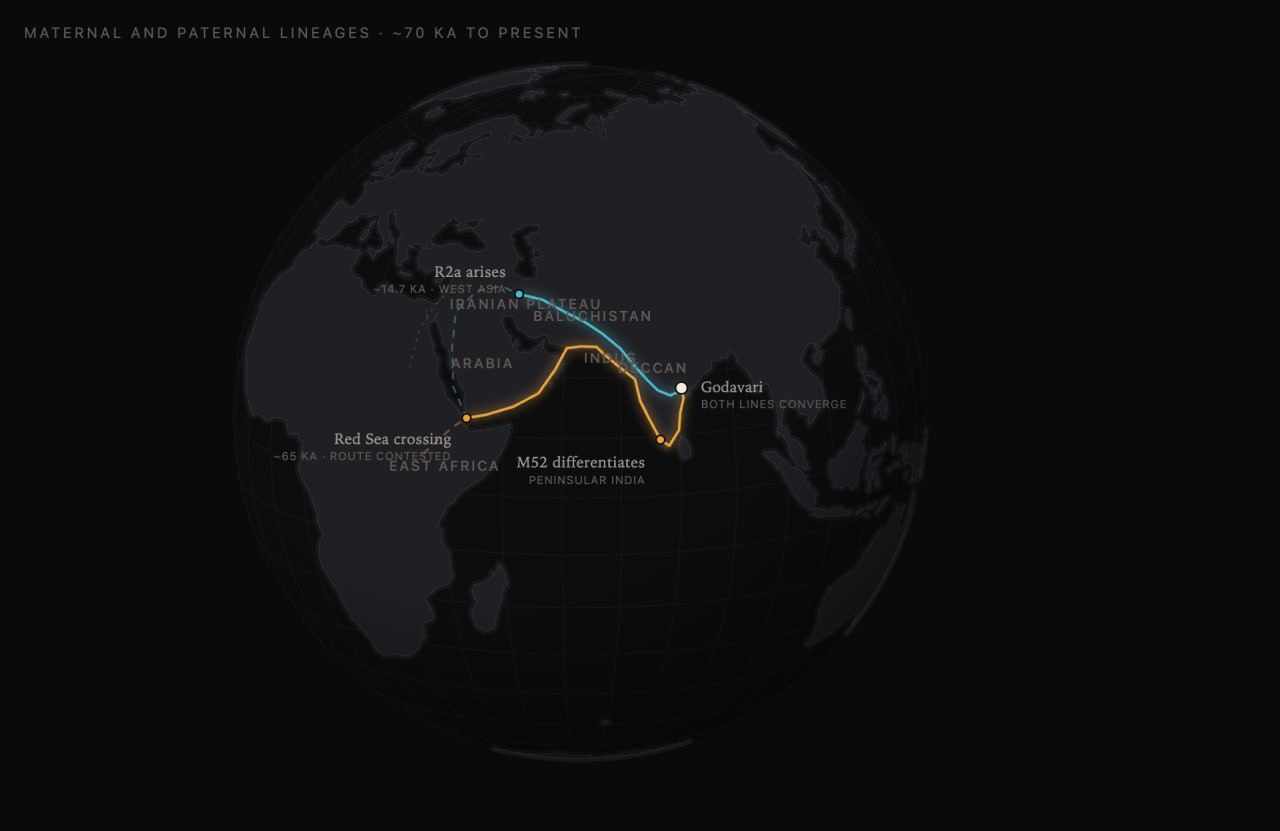
M52. R-L266. Two identifiers on a 23andMe results page that most people glance at once and never think about again.
I thought about them for months.
This is what I found when I refused to accept the first answer.
What a Haplogroup Actually Is
Before the story, a note on the tool.
A haplogroup is a branch on the human family tree, defined by mutations that accumulated over tens of thousands of years. Your maternal haplogroup traces your mother’s mother’s mother’s line — an unbroken chain of women stretching back to Africa. Your paternal haplogroup does the same for your father’s line.
Everything else in consumer genetics — the ethnicity percentages, the cousin matches, the small slivers of improbable geography — is statistical inference across your whole genome. Haplogroups are different. They are specific mutations on specific chromosomes, traced one line at a time, with unusual clarity.
The problem is that services like 23andMe tell you what you are, not what it means.
M52 is a South Asian maternal lineage within macrohaplogroup M, a deeply rooted and highly diverse lineage across the Indian subcontinent. R-L266 sits under R2a, a paternal lineage concentrated in the subcontinent. That much I could get from Wikipedia.
But the real question was harder: where did these lines come from, when did they diverge, and how did they end up converging in the same person, in the Godavari basin of Telangana?
70,000 BCE: One Shore, One Crossing
Every non-African alive today descends from a small founding population that passed through a severe bottleneck after leaving Africa.
Around 70,000–65,000 BCE, a population carrying the mtDNA super-haplogroup L3 left Africa — through either the Bab-el-Mandeb strait (the narrow channel between the Horn of Africa and the Arabian coast) or the Sinai corridor in the north. The Bab-el-Mandeb southern route has long been the favoured model, but modern human fossils from Israel at roughly 55,000 years ago and Neanderthal admixture patterns shared across all non-Africans mean the northern route cannot be ruled out. The exact crossing remains unresolved, and neither genetic nor archaeological evidence has settled the question. What is clear is the bottleneck itself: estimates of the group size vary, but the shallow diversity of all non-African DNA today makes its severity visible.
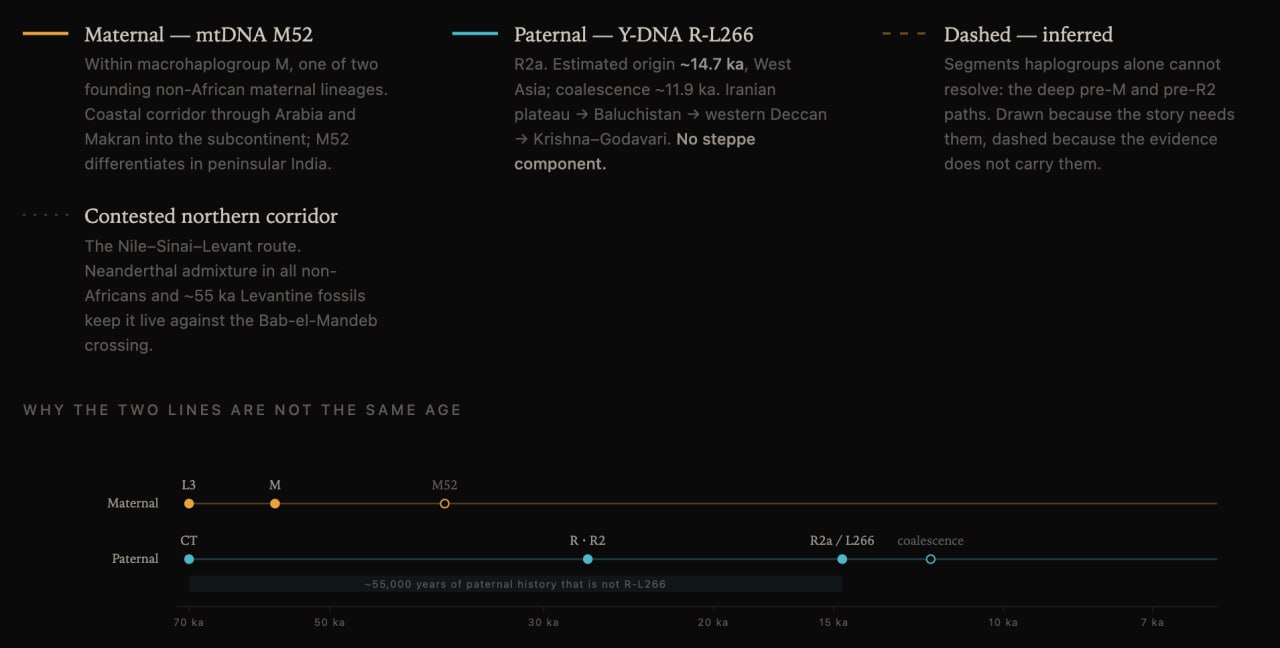
My maternal line descends from haplogroup M, one of only two founding non-African maternal lineages (the other is N). Both branch directly from L3. My paternal Y-chromosome connects through haplogroup CF — one of the two major founding non-African paternal lineages — which sits within the broader CT clade. CT itself predates the Out-of-Africa dispersal by roughly 20,000 years, so the useful founding parallel is CF (alongside DE), not CT.
At the deepest level, both my maternal and paternal lines trace back to the same broad Out-of-Africa dispersal, though their exact routes cannot be reconstructed from haplogroups alone. They diverged over the next 50,000 years.
65,000–45,000 BCE: The Coastal Highway
After the crossing, the two lines took different routes.
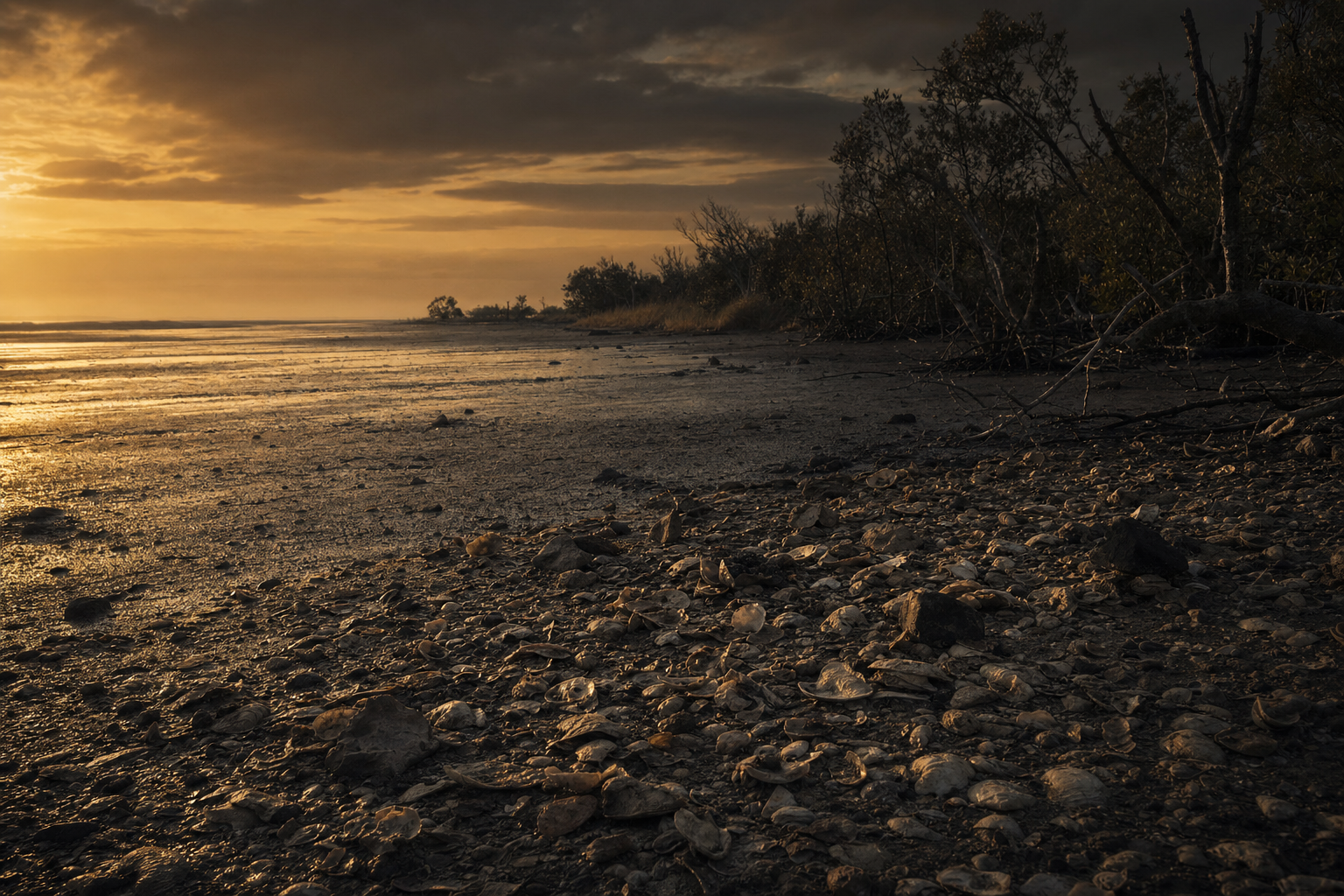
The maternal M line moved fast. It followed the southern coastal corridor — the “beachcomber” migration — hugging the Indian Ocean shoreline through Arabia, the Persian Gulf coast, and Baluchistan into the subcontinent. The evidence for this route sits in coastal shellfish middens: ancient refuse heaps of cracked shells marking camps that no longer exist above water. Sea levels were lower then. Much of the route is now underwater.
M diversified explosively once it entered South and Southeast Asia, suggesting a population expanding rapidly into relatively empty territory. The sublineage M52 — my maternal branch, an mtDNA haplogroup formally characterised in Eaaswarkhanth et al. (2010) — differentiates in peninsular India. Its precise regional distribution is not yet fully mapped in published literature; an association with peninsular, Dravidian-speaking populations is plausible from the broader M distribution, but any Godavari-specific presence is narrative inference rather than documented frequency data. (M52 also designates a Y-chromosome haplogroup in some sources; here it refers to the mitochondrial lineage only.)
The paternal line took the longer, slower northern arc. The chain K2 → P → R developed somewhere in Central or West Asia over tens of thousands of years. R2a/R-L266 is a paternal lineage strongly concentrated in South Asia today. Its parent clade R2 (M479) has an estimated coalescence of roughly 27,000 BP; the R-M124 sublineage branched off around 14,700 BP with probable origins in West Asia, entering the subcontinent via the Iranian plateau or the Makran coast. This ancestry predates the Steppe-associated expansions by many millennia, though the exact path into South Asia remains debated (Kivisild et al., 2003).
45,000–10,000 BCE: The AASI Foundation
Both lines converge here.
The Ancient Ancestral South Indians — AASI — are the founding population of peninsular India. They formed after the initial peopling of the subcontinent, becoming genetically isolated from other East-Eurasian populations around 45,000 years ago. This isolation lasted long enough to create a distinct genetic profile that is still detectable today as a deep substrate across South Indian populations.
My maternal M52 differentiates within this AASI population. My paternal R-L266 establishes itself in the same region.
The Irula — a hunter-gatherer tribal population of Tamil Nadu — have been proposed as a cleaner proxy for AASI ancestry than the Andamanese, since the S-component extracted from Irula samples shows minimal West Eurasian admixture (Yelmen et al., 2019). The Andamanese (Onge) remain the reference population in much current modelling, including the 2025 Cell study of 2,762 Indian genomes; the proxy debate is live rather than settled. Both approaches converge on the same conclusion: a deep South Asian hunter-gatherer substrate, distinct from all West Eurasian and East Asian populations, that underlies modern South Indian ancestry.
My uniparental markers belong to this deep layer. Pre-Neolithic. Pre-farming. Tens of thousands of years before any of the kingdoms, languages, or agricultural civilisations that followed.
3200–1750 BCE: The Ashmound People
While the IVC was reaching its peak in the northwest, something distinct was happening in the south.
Agro-pastoral communities appeared in the Raichur and Shorapur Doabs of Karnataka — the flat, fertile land between the Tungabhadra, Krishna, and Hagari rivers. They built ashmounds.
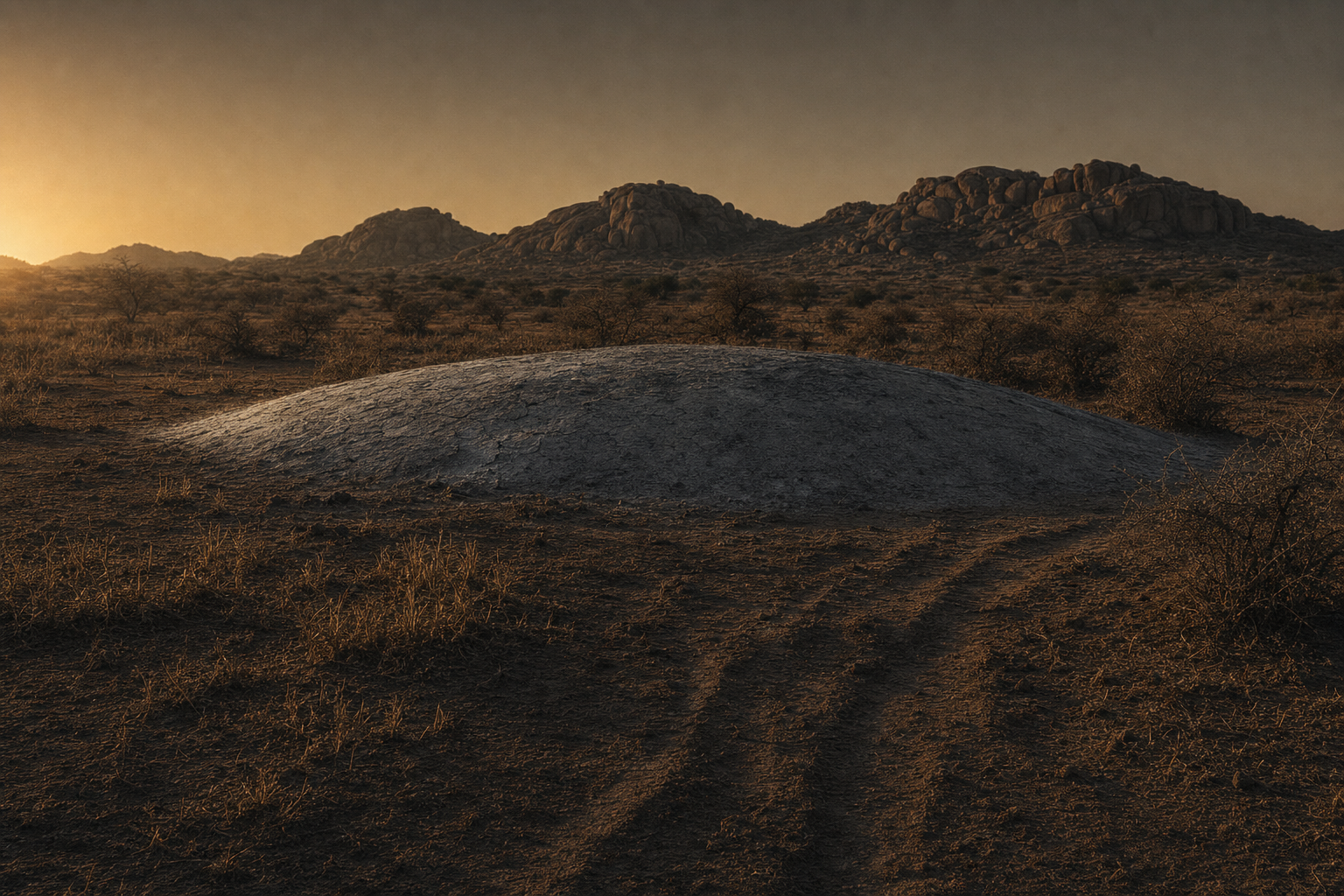
An ashmound is what it sounds like: a large accumulation of vitrified cattle dung, burned in seasonal cattle pens. Some are as large as a football field. Robert Bruce Foote, the geologist who first systematically recorded Indian prehistoric sites in the 19th century, documented over 200 of them. The people who built them cultivated indigenous millets — Brachiaria ramosa and Setaria verticillata — before any of the wheat or rice that would arrive later. Their primary wealth was cattle: large-humped Bos indicus herds that represented status, ritual, and subsistence simultaneously.
These communities likely drew heavily from local Deccan populations, but without direct ancient DNA from the ashmound sites, their precise genetic profile remains inferred rather than demonstrated. They were not migrants from the northwest. They were the indigenous pastoral peoples of the Deccan, expanding gradually south from around 3200 BCE, crossing the Tungabhadra into southern Karnataka by 2500 BCE, and pushing further into the Upper Krishna basin in the subsequent centuries.
AMS radiocarbon dates from Sanganakallu-Kupgal — one of the most intensively studied ashmound complexes — show mound formation concentrated between 1950 and 1750 BCE, followed by centuries of intensive village occupation on the mound surface. Paddayya’s excavations at Budihal challenged the older view of ashmounds as purely seasonal camps, revealing evidence of year-round habitation. African crops begin appearing: finger millet (Eleusine coracana) and sorghum arriving through Indian Ocean maritime contact networks — an exchange moving in both directions across the ocean that connected India and East Africa long before any written record of it. Fuller’s revised estimates for Eleusine coracana in South Asia push the archaeobotanical evidence somewhat later than the 2000 BCE figure often quoted; the timing of this exchange is still being refined.
3300–1900 BCE: What Was Happening to the Northwest
Simultaneously, something very different was unfolding 1,500 kilometres away.
The Indus Valley Civilisation had reached its mature phase — urban planning at Mohenjo-daro and Harappa, standardised weights and measures, a still-undeciphered script, and trade networks reaching Mesopotamia. Its people carried a mixture of Iranian farmer-related ancestry and AASI — what Narasimhan et al. (2019) called the “Indus Periphery Cline” — the foundational genetic profile of most modern South Asians.
Around the IVC core sat a ring of related and interacting cultures: the Kulli (Balochistan, ~2600 BCE) with its distinctive animal-frieze pottery; the Amri-Nal (Sindh, ~3800–2600 BCE); the Ahar-Banas (Rajasthan, ~3300 BCE) with its black-and-red ware; the Anarta-Padri communities of Gujarat; and the Sorath Harappan in Saurashtra — what Possehl (1992) identified as a regional variant that developed from indigenous Gujarati traditions rather than being simply a colonial outpost of Sindhi urbanites.
My paternal R-L266 lineage was somewhere in this broader zone during this period.
1900–1600 BCE: The IVC Deurbanises
The mature Harappan phase ends without a single clean cause. The cities are abandoned over generations. Populations disperse — east into the Gangetic plain, and south into the Deccan.
This dispersal has a southern terminus we can locate precisely: Daimabad, on the Pravara River (a Godavari tributary) in Maharashtra’s Ahmednagar district. It is the southernmost site showing direct Harappan influence. Excavated in successive campaigns from 1958 to 1979, it reveals five distinct cultural phases. The Late Harappan phase includes mud-brick structures, terracotta button-seals bearing Indus symbols, and one of the most extraordinary finds in Indian archaeology: the Daimabad bronze hoard — four sculptures, including a chariot pulled by oxen, now in Mumbai’s Chhatrapati Shivaji Maharaj Vastu Sangrahalaya.
The Sorath Harappan tradition extends from Gujarat through this Deccan corridor. The same river system that connects Daimabad to the Godavari watershed would carry populations — and their genetic signals — further south over the centuries that followed.
2200–1400 BCE: The Deccan Chalcolithic Sequence
The regional Deccan chronology established by Shirvalkar and Prasad (2016) runs: Savalda (~2200–2000 BCE) → Late Harappan (~2000–1800 BCE) → Daimabad phase (~1800–1600 BCE) → Malwa (~1600–1400 BCE).
Daimabad grows to roughly 20 hectares by its peak. Excavators identified specialised households — butchers, lime-makers, potters, bead-makers, merchants — and mud fortification walls with bastions. A bronze mother goddess with a fan-shaped head resembles figures from Mohenjo-daro. As Ahluwalia (2024) puts it: “Harappans arrived and eventually blended with the existing local traditions — despite differences, the cultural fabric remained the same.”
The Malwa culture, originating in central India around Navdatoli and Kayatha, spreads into Maharashtra by 1600 BCE, bringing northern Chalcolithic traditions into contact with the existing Neolithic-Chalcolithic communities of the Deccan (Dhavalikar, 1979). This is the archaeological trace of the admixture event that produces the ASI genetic component — IVC-related ancestry (Iranian farmer + AASI) blending with higher-AASI local populations. Dravidian languages, or languages ancestral to later Dravidian branches, may have been present in parts of the Deccan by this period, but the linguistic map remains uncertain.
1400–1000 BCE: The Jorwe Culture and the Godavari Heartland
The Early Jorwe phase represents the Deccan Chalcolithic at its peak. Its nucleus is the Pravara-Godavari basin — the very river system where my haplogroups were already established.
Major sites line the valleys: Prakash on the Tapi, Daimabad and Nevasa on the Godavari, Inamgaon and Chandoli on the Bhima. Settlements feature rectangular mud houses arranged along lanes, oval fire pits, storage platforms, irrigation channels, and at Inamgaon, evidence of a jetty. The culture bridges north and south: barley and wheat from the IVC agricultural tradition, finger millet, sorghum, and horse gram from the Southern Neolithic. A chiefdom may have emerged at Inamgaon, with higher-status figures occupying larger, centrally located multi-room houses (Sankalia, Ansari and Dhavalikar, 1971).
The Jorwe people buried their dead with feet cut below the ankle — possibly to prevent the spirit from returning to the world of the living.
1200–300 BCE: Iron, Megaliths, and the Making of Dravidian South India
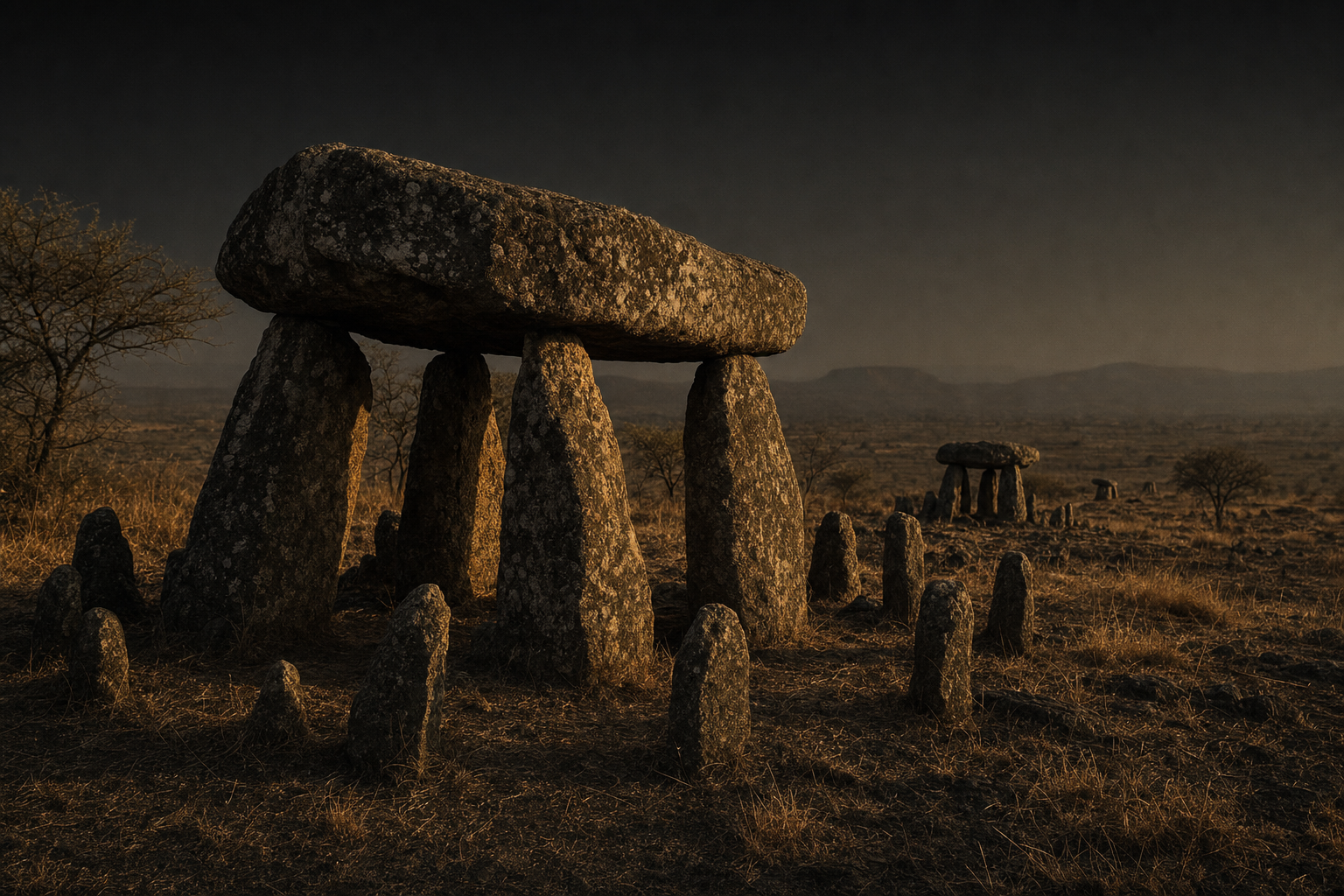
The Southern Megalithic Complex emerges across Karnataka, Andhra Pradesh, Telangana, and Tamil Nadu from around 1200 BCE. Iron tools and Black-and-Red Ware pottery define the material culture. Dolmens, stone cist burials, stone circles, and menhirs appear across the landscape. Hallur in Karnataka and Adichanallur in Tamil Nadu are among the earliest sites.
This is the moment when the two population streams — IVC-admixed Deccan Chalcolithic groups moving south and the deep AASI populations of South India — fully merge to produce the ASI (Ancestral South Indian) component that dominates modern Dravidian genomes.
Proto-South Dravidian gave rise to the Tamil-Kannada branch, including Tamil, Malayalam and Kannada, while Telugu belongs to the South-Central Dravidian branch; these lineages had begun diverging around 1500 BCE. By the end of the Iron Age, these languages have their basal characteristics. Megalithic traditions spread widely across the Deccan and South India, including the Krishna-Tungabhadra, Godavari and Kaveri regions. Keeladi on the Vaigai river shows evidence of urban-level settlement and potsherds with markings interpreted as Tamil-Brahmi script. The excavators’ proposed 6th-century BCE dating is contested: the ASI and scholars including Bishnupriya Basak have raised concerns about stratigraphic consistency and whether inscribed potsherds came from the same layers as the dated samples. The site is significant; the specific century is in dispute. The population formation visible in modern South Indian genomes is largely complete.
The Admixture Window, Dated Genetically
Moorjani et al. (2013) dated the ANI-ASI admixture event to 4,200–1,900 years ago — roughly 2200 BCE to 100 CE. This maps precisely onto the archaeological sequence above.
ANI (Ancestral North Indian) = Indus Periphery Cline + Steppe pastoralist ancestry. ASI (Ancestral South Indian) = Indus Periphery Cline + higher AASI. The genetic archive and the archaeological record are telling the same story through different languages.
Dravidian speakers show significantly higher AASI-related ancestry than Indo-Aryan speakers, and higher total IVC ancestry — a pattern consistent across datasets. The Cell 2025 study of 2,762 Indian genomes reports AHG-related ancestry ranging from roughly 19% to 69% across Dravidian-speaking populations; Indo-Aryan-speaking groups are consistently lower but with substantial within-group variation. Exact proportions depend on the admixture model and reference populations used. Some Telugu-speaking caste groups from the Godavari and wider Deccan region likely reflect varying mixtures of AASI-rich southern ancestry and ancestry related to northern or northwestern populations, but exact proportions vary by dataset and sampling method.
The Convergence: Bhadrachalam
The two lines — one from the deep AASI south, one tracing a longer arc through the northwest and down the Deccan corridor — converge somewhere in the Godavari basin.
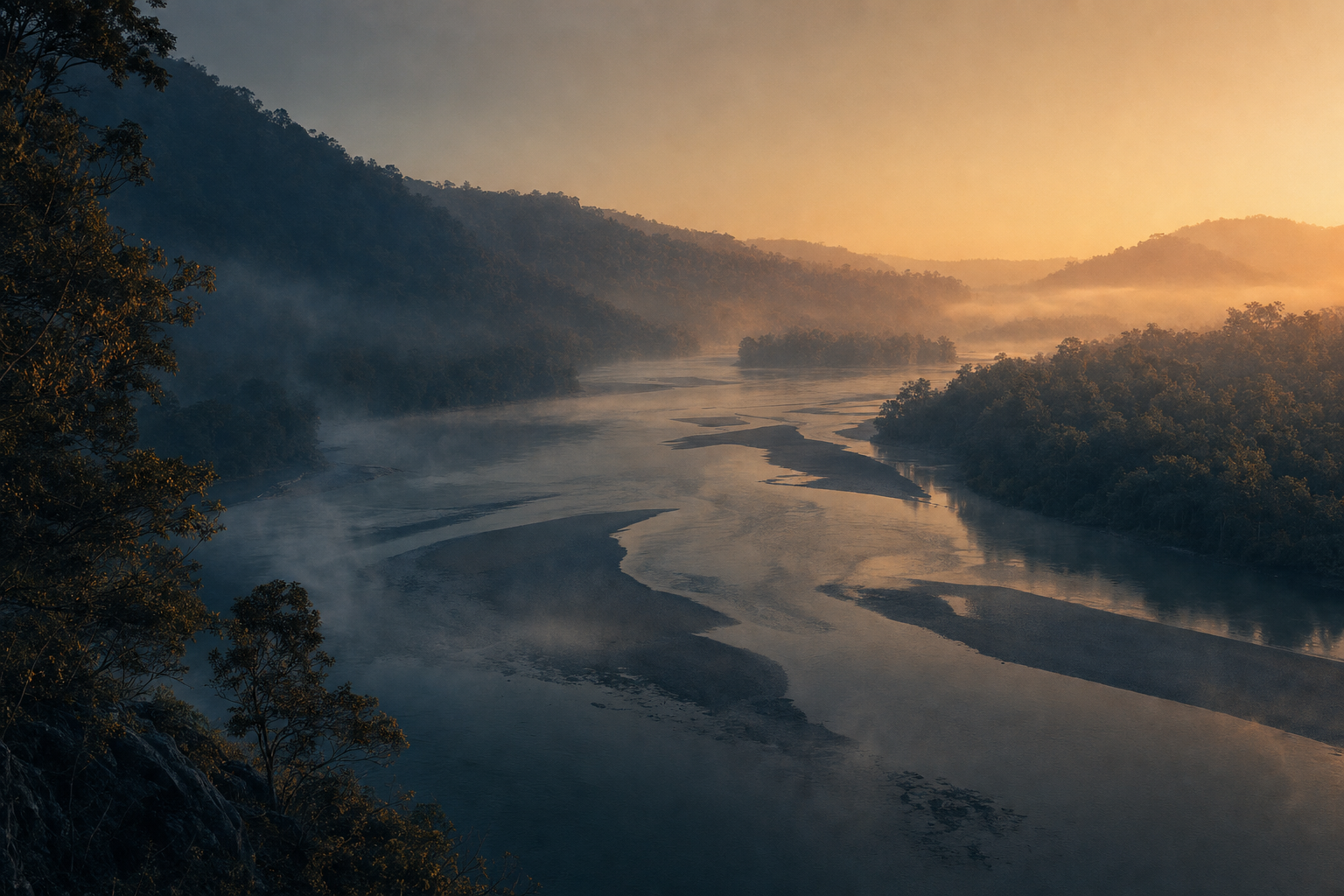
My father’s origins are in Bhadrachalam, at the point where the Godavari cuts through the Eastern Ghats. This is not accidental geography. The Godavari valley is one of the oldest inhabited corridors in South Asia, connecting the eastern Deccan to the coast, the tribal highlands to the agricultural plains.
The Koya — the dominant tribal community around Bhadrachalam — show deep indigenous South Asian lineages, not the incoming agricultural signals I was tracing on the paternal side. They are the substrate: the AASI-rich population that was there long before any later arrivals.
My paternal line represents a later arrival into that substrate. The Bhil of Gujarat carry R2a at notable frequencies, and the broader haplogroup gradient — concentrated in northwestern and western South Asia, declining through the Deccan — suggests a dispersal chain: northwest → western Deccan → Krishna basin → Godavari. The Chenchu of the Nallamala Hills appear in the same literature, but their notable frequency in Kivisild et al. (2003) is R1a (26%), not R2a; the southern anchor of this chain is inferred from the regional gradient, not a Chenchu-specific frequency.
The Dandaka and Mulaka regions — the Godavari heartland — are where the two streams merged. The ashmound builders, the Jorwe farmers, the Megalithic iron-workers, the incoming agro-pastoral streams from the northwest: they all contributed threads to the same tapestry. My haplogroups are just the oldest ones.
After about 300 BCE, the broad population formation visible in modern South Indian genomes was largely in place, but the social world was still changing. In the Godavari basin, ancient ancestry became layered through Satavahana, Vengi, Kakatiya, Musunuri, Qutb Shahi, Nizam and colonial systems. Around Bhadrachalam, this was not a settled caste heartland but a river-forest frontier, where Telugu-speaking cultivators, military retainers, temple-centred settlers and revenue intermediaries interacted with older Koya and Konda Reddi communities of the Godavari hills.
My paternal identity from Bhadrachalam is therefore best understood not as a single ancient tribe, but as a Telugu agrarian-frontier identity: cultivators, protectors, village men, occasional soldiers and landholding families whose caste label hardened over the medieval and colonial periods. My father’s line likely comes from this world — not purely coastal, not purely tribal, but from the Godavari frontier where plains Telugu society met the forested Deccan.
What I Actually Know, and What Is Still Inference
I want to be precise about what this evidence does and does not establish.
The firm evidence is this: my maternal line belongs to macrohaplogroup M, one of the deepest and most diverse maternal lineages in South Asia. My paternal line, R-L266/R2a, belongs to a lineage strongly concentrated in South Asia today, though its deeper route into the subcontinent is still debated.
The wider genetic history is also clear in outline: modern South Asians formed through layered mixtures involving AASI-related hunter-gatherer ancestry, Indus Periphery-related ancestry, and later Steppe-related ancestry in varying proportions. The ANI–ASI mixture window falls broadly between 2200 BCE and 100 CE.
What remains inference is the precise path my paternal line took into the Godavari basin, the exact population that carried my maternal M52 branch, and the relationship between these haplogroups and specific archaeological cultures such as the ashmound builders, Jorwe farmers, or Megalithic communities. Those connections are plausible narrative bridges, not direct genetic proof.
An honest map with blank spaces is better than a complete one drawn from wishful thinking.
On Method
This investigation would have been almost impossible without AI assistance. Not because the machine knew things I did not, but because the synthesis problem is genuinely hard. Population genetics, Deccan archaeology, tribal ethnography, ancient DNA studies, and local geography are normally siloed. No single paper, no single expert, was going to connect all of these for me.
The AI could hold the full scope in working memory, surface relevant papers, and revise the model when I pushed back. Several of the most important corrections came from me knowing the local geography and asking sharper questions. The AI got things wrong. It overstated weak evidence. It sometimes presented plausible inference as settled history.
But that process — assert, challenge, revise — produced something more honest than either of us would have reached alone.
Two codes on a consumer genetics results page. One ancient, settled, southern. One long-traveled, western-arc, eventual. Both Indian for longer than the word “Indian” has existed.
Key sources: Narasimhan et al. (2019), Science 365(6457) · Moorjani et al. (2013), AJHG 93(3):422–438 · Shinde et al. (2019), Cell 179(3) · Fuller et al. (2007), Antiquity 81(313):755–778 · Sali (1986), Daimabad 1976–79 (ASI) · Shirvalkar & Prasad (2016), in A Companion to South Asia in the Past (Wiley) · Dhavalikar (1979), in Essays in Indian Protohistory · Sankalia, Ansari & Dhavalikar (1971) · Korisettar et al. (2001) · Possehl (1992) · Yelmen et al. (2019) · Eaaswarkhanth et al. (2010), EJHG 18:354–363 · Kivisild et al. (2003) · GenomeIndia Consortium (2025), Nature Genetics